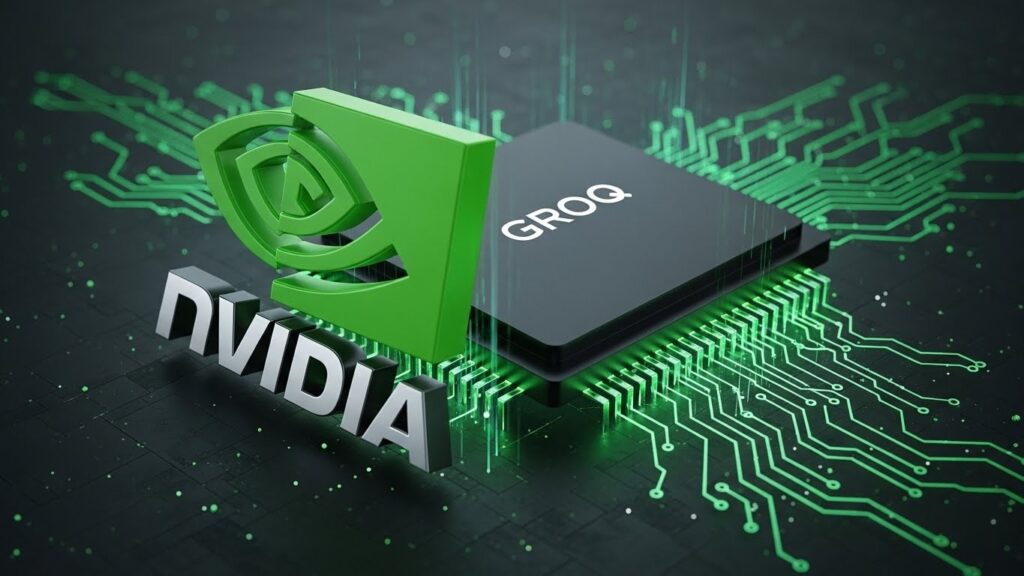
Nvidia and Groq Forge Strategic Alliance: A Paradigm Shift in AI Hardware
The artificial intelligence hardware landscape has just experienced a seismic shift. In a move that redefines the competitive dynamics of the semiconductor industry, AI chip titan Nvidia has entered into a major strategic partnership with Groq, the rapidly rising star known for its ultra-fast inference processors.
This unexpected collaboration, which includes a non-exclusive licensing deal for Groq’s proprietary inference chip technology and the acquisition of key engineering talent, signals a new era in how AI computation is structured, scaled, and delivered to the market.
The Convergence of Training and Inference
To understand the magnitude of this partnership, it is essential to look at the two primary phases of artificial intelligence computing: training and inference.
Nvidia has long held a near-monopoly on the training side of AI. Their powerful GPUs (Graphics Processing Units), such as the H100 and the upcoming Blackwell architecture, are the undisputed workhorses used to build massive foundational models like OpenAI's GPT-4 or Google's Gemini. However, as these models are deployed into production to serve millions of users globally, the computational bottleneck shifts from training the models to running them—the inference phase.
This is where Groq has carved out its formidable reputation. Founded by former Google TPU engineers, Groq designed its Language Processing Units (LPUs) from the ground up specifically for inference. By prioritizing deterministic, single-core architecture, Groq achieves processing speeds that drastically reduce latency, allowing large language models to generate text almost instantaneously.
By partnering with Groq, Nvidia is acknowledging that while GPUs remain the king of training, specialized architectures are increasingly vital for cost-effective, high-speed inference at scale.
Details of the Strategic Deal
The partnership is structured around two key pillars: technology licensing and talent acquisition.
1. Technology Licensing:
Nvidia has secured a non-exclusive license to integrate aspects of Groq’s inference architecture into future Nvidia product lines. This is a crucial strategic maneuver. Instead of attempting to entirely replicate Groq's deterministic processing approach from scratch—which would require years of R&D—Nvidia can now leverage proven, cutting-edge inference tech to bolster its own offerings. For Groq, the licensing fee injects massive capital into their operations, validating their technology on the biggest stage possible.
2. Strategic Talent Acquisition:
As part of the agreement, a select group of Groq's top engineers and hardware architects will transition to Nvidia. This "acqui-hire" element ensures that Nvidia not only possesses the intellectual property but also the human capital necessary to integrate and evolve the technology seamlessly within their broader ecosystem.
Market Implications: Consolidation and Competition
The immediate market reaction underscores the gravity of this alliance. Nvidia's move is a defensive masterstroke, neutralizing a potential long-term threat by absorbing Groq's primary advantage into its own arsenal.
For the broader AI industry, this partnership has several profound implications:
- Accelerated AI Deployment: With Nvidia potentially releasing hybrid chips or specialized inference accelerators utilizing Groq's architecture, enterprise customers can expect significantly lower latency and reduced operational costs when deploying AI models. This will accelerate the integration of AI into real-time applications, from high-frequency trading algorithms to instantaneous customer service bots.
- Pressure on Competitors: The alliance puts immense pressure on other AI hardware competitors, particularly AMD and Intel, as well as custom silicon efforts from hyperscalers like Amazon (Trainium/Inferentia) and Google (TPU). Nvidia is no longer just the undisputed leader in training; it is aggressively fortifying its position in the inference market.
- The Future of AI Startups: Groq’s trajectory—from a disruptive challenger to a strategic partner of the industry giant—provides a compelling blueprint for other hardware startups. It highlights that specialized innovation, particularly in solving specific bottlenecks like inference latency, can yield massive strategic value, even if it doesn't immediately dethrone the incumbent.
Conclusion
The Nvidia-Groq partnership is more than just a corporate handshake; it is a strategic alignment that reflects the maturing of the AI lifecycle. As the industry transitions from the initial frenzy of model training to the practical realities of mass-scale deployment, inference efficiency becomes paramount.
By bridging Nvidia’s unparalleled scale and training dominance with Groq’s laser-focused inference speed, this alliance promises to push the boundaries of what is computationally possible. For developers, enterprises, and everyday users interacting with AI, the results will be faster, more efficient, and more capable digital experiences. The AI hardware wars have entered a new, highly collaborative phase, and the pace of innovation shows no signs of slowing down.